Should an AI Agent Be Allowed to Open PRs Without a Human in the Loop?
Oct 28, 2026 · 7 min read · by Jordan Kwan
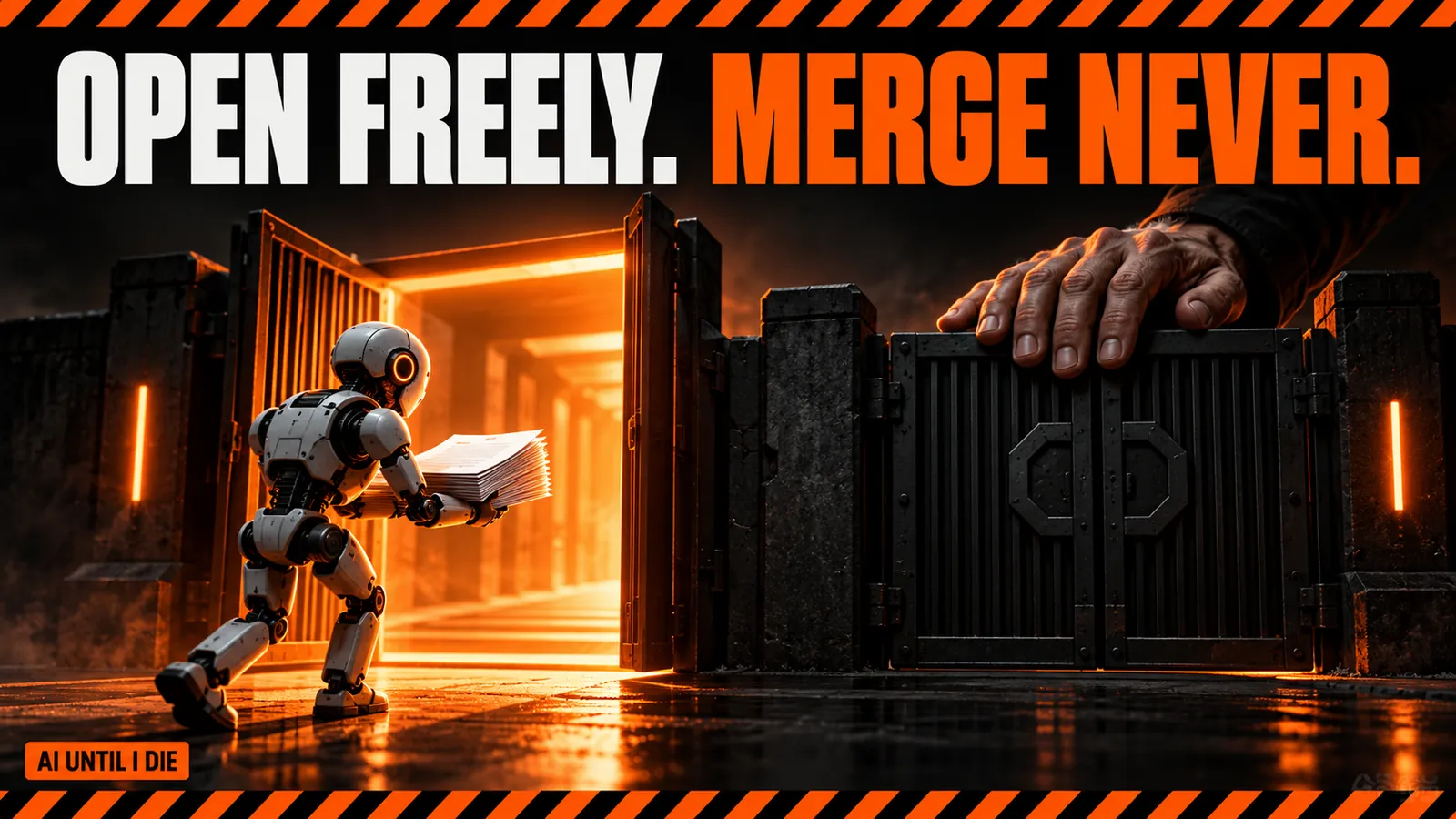
TL;DR: Yes to opening, no to merging, and the distinction is the whole policy. A pull request opened by an agent on its own branch changes nothing in production. It creates a reviewable artefact: a diff, a description, a place for checks and comments. Letting agents open PRs without asking permission first is what makes agent work visible and auditable. Letting an agent merge, approve its own work, or push to a protected branch without a human is where the line sits, because merge is the irreversible step where a plausible mistake becomes everyone's problem. Keep the human at the merge, keep the agent off main, and the arrangement is not reckless. It is just version control working as designed.
Key Takeaways
- Split the question. Opening a PR, reviewing a PR, approving a PR, and merging a PR are 4 different permissions, and a policy that treats them as one decision will get all four wrong.
- The PR is a safety mechanism, not a risk. Work an agent does inside a branch and a PR is contained, diffable, and reversible. Work an agent does by pushing directly is none of those things.
- The human belongs at the merge because merge is the step that is expensive to undo and the step where accountability has to live. A named person decided this code ships. That sentence must always have a true subject.
- Agents must never approve their own PRs or review their own diffs as the deciding check. Self review is useful signal and worthless governance, for the same reason students do not grade their own exams.
- Autonomy should be earned per category of change, not granted per agent. A docs fix and a migration are both PRs. They are not the same risk and should not travel under the same rules.
Why is opening a PR the safe step, not the dangerous one?
Because of what a branch is. An agent working on an isolated branch can rewrite, experiment, and fail at full speed while the main branch stays exactly as it was. Opening a pull request proposes that work and formats it for inspection: the change, the stated reason, the automated checks, a place for human comments. It is the moment hidden agent activity becomes governed work. The dangerous arrangements are the ones without PRs: an agent committing straight to a shared branch, or making changes no one can diff after the fact. The failure stories in how an agent deletes a production database are stories about agents with direct reach into live systems, not about agents whose work sat in a branch waiting for review.
Requiring a human to approve the opening of a PR, step by step, also has a cost people underestimate: it makes the human a bottleneck for the act of proposing, so teams route around it, and the agent ends up working in less visible ways. A permission prompt for every draft buys no safety, because nothing has shipped, and it spends reviewer attention that should be saved for the merge decision. Let the agent propose freely. Spend the human on the judgement that matters.
What rules make agent PRs safe to allow?
Four rules carry nearly all of the weight. First, branch only, enforced by the platform rather than by instructions: the agent's credentials cannot push to protected branches, because a rule the agent is merely asked to follow fails on the one confusing afternoon when it matters. Second, a human merges, every time, with no standing approvals and no exceptions for small changes, because small changes are where reviewers stop looking. That is the operating policy behind this site's own build work: agents build on branches and open PRs, and a named human gives the word for each specific merge.
Third, checks before eyes: the PR must pass the project's automated gates before a human is asked to read it, and a failing PR is the agent's problem to fix, not the reviewer's to diagnose. Fourth, the review follows a risk order rather than a full line by line read by default, the workflow in how to review agent-written code without reading every line: claim against diff, scope, trusted tests, then the risky lines in full. Together the four rules gate agent output at one well defended point.
Where does this policy break, and what sits beyond the line?
It breaks when the review degrades. If PRs arrive faster than a human can honestly review them, the merge gate becomes a rubber stamp and the policy is theatre. Volume is the real enemy, and the honest responses are to limit agent work in flight, split changes smaller, or narrow what the agent is asked to do. It also breaks on changes whose risk hides outside the diff: dependency upgrades, configuration and permissions changes, data migrations, anything touching authentication or payments. Those categories deserve a full read and possibly a second human, whatever the agent's track record.
Beyond the line entirely: an agent merging its own PR, an agent approving another agent's PR as the sole reviewer, an agent changing the rules that govern agents, and an agent with standing permission to ship a category of change because it has gone well so far. Track record arguments fail here because agent failure is not evenly distributed. The failure modes catalogued in what actually breaks in coding agents are confident, plausible, and rare per change, which means a long clean streak is weak evidence about the next change and no evidence at all about the tail risk. The streak is exactly when merge discipline gets retired, and exactly when it is needed.
Is this just slowing agents down to make humans comfortable?
No, and the framing matters. The merge gate is not a comfort blanket, it is the point where accountability attaches. When agent written code causes an incident, the questions that follow are who decided this was safe to ship and on what evidence. If the answer is that the system approved itself, there is no accountable decision to examine, only a design failure to regret. Keeping a human merge also keeps a human understanding: the reviewer who merges agent work weekly maintains a working model of the codebase, while a fully hands off pipeline produces a team that can no longer evaluate the system it owns, the trap in agents are just cron jobs with anxiety.
The speed cost is smaller than it looks. Agents work in parallel and wait cheaply, and a PR that waits two hours for a merge loses nothing if three more are being drafted meanwhile. The scarce resource is reviewer judgement, and this policy spends it once, at the step where it changes the outcome.
FAQ
Can an agent ever merge on its own for trivial changes, like typo fixes?
Resist it. Trivial is a judgement the merging party would have to make, and automated triviality classifiers are just agents approving agents with extra steps. A human merge on a typo PR takes seconds, and keeping zero exceptions keeps the rule enforceable on the day the change is not actually trivial.
What about a second agent reviewing the first agent's PR?
Useful as a check, inadmissible as the gate. An independent model catches real errors and adds a genuine second pass, so run it before the human looks. But two systems with correlated blind spots approving each other is not accountability, and when something ships broken, an agent reviewer cannot own the decision. Signal yes, signature no.
Does this apply to non code changes, like agent drafted content or configuration?
The same shape applies wherever a publish or apply step exists: let the agent draft freely in a contained state, gate the step that makes it real, and hold that gate with a human for anything that is public, irreversible, or expensive to retract. Drafting is cheap. Shipping is the decision.
Bottom Line
Let agents open pull requests without asking, on branches they cannot escape, with checks that run before a human reads a line. Keep the merge human, every time, with no standing approvals and no self review as the deciding vote. That split gives you the actual benefit of agent development, parallel drafting at machine speed, while keeping the one property no team can automate away: a person who can stand behind the decision to ship.
Written by Jordan Kwan, founder of Reachium.
I build Reachium, the LinkedIn outreach platform behind the tactics you just read. Same brain, live product.
See what Reachium does ↗Prefer the long version first? What Reachium is and how it works