Why Does ChatGPT Cite Some Sites and Never Others? It Is a Chain of Filters
Oct 29, 2026 · 6 min read · by Jordan Kwan
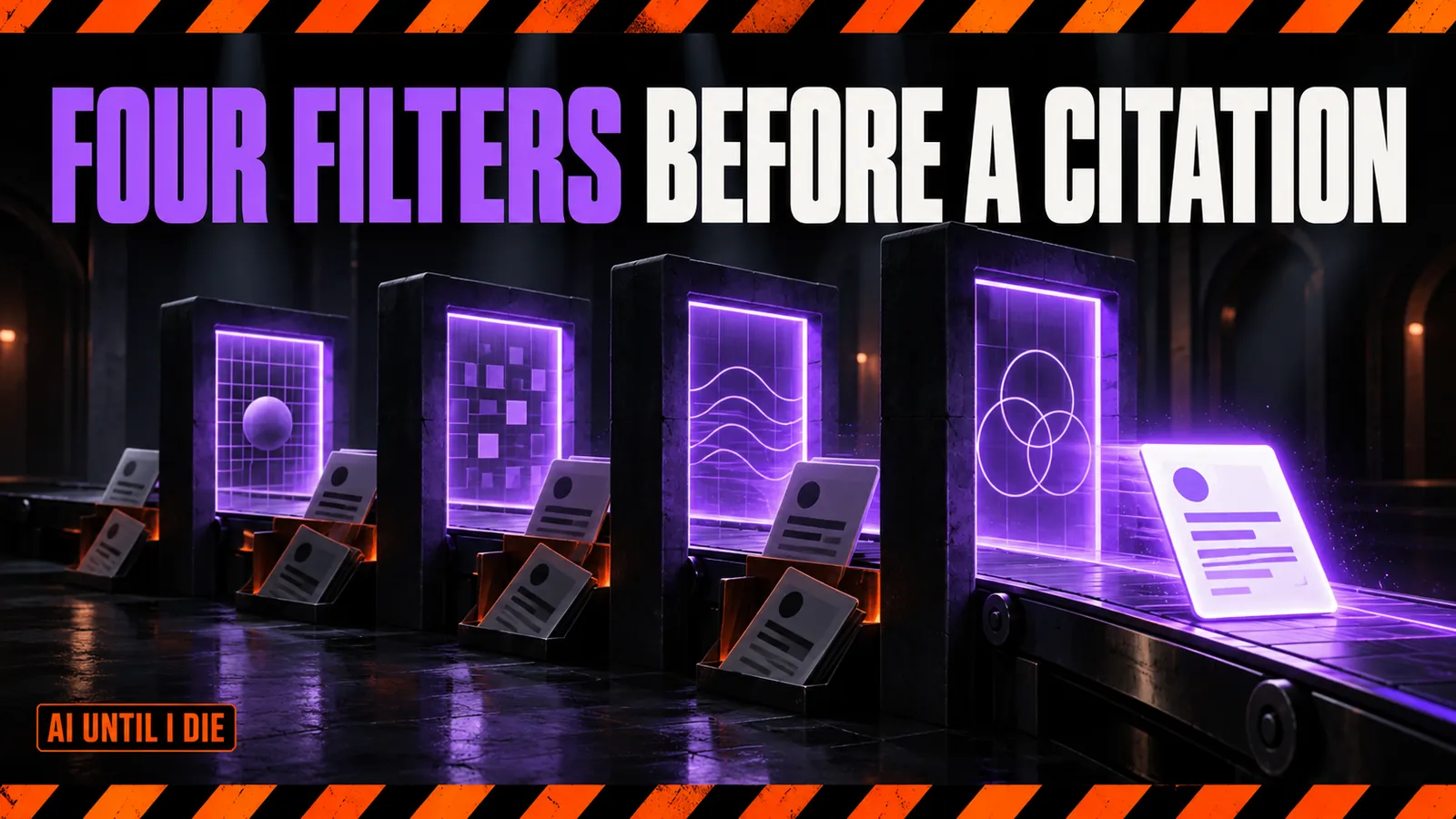
TL;DR: ChatGPT does not pick favourite sites in one decision. A citation is the output of a chain: the system has to retrieve candidate pages for a query, judge which ones answer it, extract material it can use, and prefer sources that fit the question, including its freshness needs. A site that is never cited may be failing at retrieval, at relevance, at page usability, or at a later selection step, and from outside those failures look the same. This post maps the filters, labels what is documented versus unknown, and deliberately claims no citation rates, because no reliable rate exists in the sources used here.
Key Takeaways
- Citation is a multi filter process, not a single ranking. Each filter can independently exclude a page.
- Retrieval comes first. A page outside the candidate pool for a query cannot be cited for that query, however good it is.
- Page features matter after retrieval. Clear answers, extractable structure, and claims stated plainly are easier for a system to use as evidence.
- Freshness is query dependent. A fast moving question penalises stale pages in a way a stable reference question does not.
- The exact weighting of the final selection step is unknown from public sources, so anyone selling a precise citation formula is guessing.
What has to happen before a citation is even possible?
Retrieval has to happen. When a question needs web material, the system gathers candidate pages that might answer it, using search style retrieval over an indexed web. That step alone explains a large share of never cited sites: if a page is not indexed, is blocked from crawling, targets different wording than the query, or sits in a topic area the retrieval step does not associate with the question, it never enters the room.
This is the same gap this site examines in why your site can rank on Google and be invisible to ChatGPT. A Google ranking proves a page can be retrieved and ranked for one system and one query set. It does not prove the page enters the candidate pool for a differently worded question in a chat interface, where queries are conversational, longer, and often carry context from earlier turns. Different door, different guest list.
Retrieval also varies by question type. Some questions are answered from model knowledge with no web step at all, in which case no site gets cited and the absence of citations says nothing about any site's quality. Treating every uncited answer as a verdict on your pages misreads a routing decision as a quality judgement.
Which page features help a retrieved page get used?
Once a page is in the candidate pool, it has to be usable as evidence. Systems composing an answer need material they can extract and attribute: a direct statement that answers the question, enough context to avoid distorting it, and a page structure that makes the relevant passage findable inside the document. Pages that bury the answer under preamble, spread one claim across 5 sections, or state conclusions without the supporting fact nearby are harder to use, even when a human reader would rate them highly.
Clarity is not the same as brevity. A thorough page can be highly citable if each section answers one sub question plainly and early. A short page can be useless if it is all assertion and no substance. Credibility cues matter at this layer too, in the ordinary sense: named authorship, visible sourcing, and consistency with other retrieved material make a passage safer to repeat. How heavily each cue is weighted in the final selection is unknown from public documentation, and this post does not pretend otherwise.
There is also a fit problem. An answer usually cites a small number of sources, so retrieved pages compete for limited slots. A page can pass every quality filter and still lose to a source that answers the same point more directly or covers more of the question in one place. Losing that contest is not a penalty. It is arithmetic.
How does freshness change who gets cited?
Freshness acts as a filter whose strength depends on the question. Ask about a stable definition and an older, authoritative page remains a good citation for years. Ask about current pricing, a recent release, or an ongoing event, and the same page becomes wrong by omission, so the system has reason to prefer material that is recent, recently updated, or clearly dated.
For publishers, the practical implication is narrow: pages about fast moving topics need visible dates and genuine updates, not cosmetic date changes. A page that claims freshness it does not have is a distortion risk for the citing system. The size of the freshness effect, and whether it differs across question categories, is unknown in the sources used here, so no number is attached to it. The direction of the effect is the usable part: staleness is a plausible silent filter for time sensitive queries, and an implausible explanation for evergreen ones.
What remains unknown about citation selection?
The final weighting. Public descriptions establish that retrieval and generation happen and that sources get selected, but they do not publish a scoring formula a publisher can optimise against directly. Claims that a specific tactic, a schema type, a word count, or a mention on a particular platform guarantees citations go beyond the documented evidence. Some tactics plausibly help at the retrieval or usability layers, which are reasoned about above. None bypasses the chain.
That uncertainty is also why citation absence is weak evidence on its own. As do AI citations matter if they send no traffic argues, citations carry visibility and trust effects separate from clicks, which makes them worth wanting. It does not make any single uncited query diagnostic. Diagnosis needs a pattern across many queries, checked layer by layer: are we retrievable, are we usable, are we current for this topic. Anything shorter is astrology with a dashboard.
FAQ
Is a site being punished if ChatGPT never cites it?
There is no evidence in the sources used here for a punishment model, and the filter chain explains silence without one. Retrieval gaps, relevance mismatches, unusable page structure, staleness on time sensitive topics, and simple slot competition each produce the same visible result. Assume a filter failure before assuming a penalty.
Do citations follow Google rankings?
Only loosely, and only through the shared retrieval layer. A strong Google presence means a page is indexable and relevant for search phrasing, which helps it reach candidate pools. Conversational queries, different retrieval behaviour, and the usability and freshness filters after retrieval all weaken the correlation. Ranking is a clue, not a predictor.
What is the first thing to check if a site is never cited?
Retrievability for the actual questions you care about. Confirm the pages can be crawled and indexed, that they target the wording users bring to chat tools, and that the answer appears plainly near the top of the page. Only after those checks does it make sense to worry about the selection layer, which is the least documented and least controllable part of the chain.
Bottom Line
ChatGPT cites the survivors of a chain: retrieval decides who is considered, page features decide who is usable, freshness decides who is current enough for the question, and a final selection step with unknown weighting decides who fits the slots available. Never cited usually means filtered somewhere, not judged and rejected as a site. Work the filters in order, keep the unknown parts labelled unknown, and distrust anyone selling exact citation rates or guaranteed selection formulas. The chain is the explanation, and it is enough to act on.
Written by Jordan Kwan, founder of Reachium.
I build Reachium, the LinkedIn outreach platform behind the tactics you just read. Same brain, live product.
See what Reachium does ↗Prefer the long version first? What Reachium is and how it works